Dialogues des Carmelites – a great performance

May 12, 2013


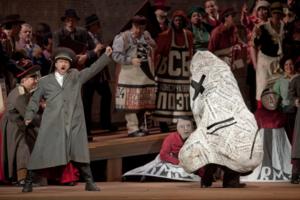
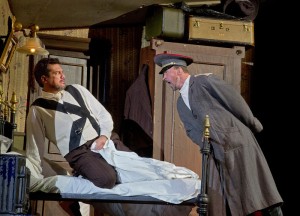
 Jean-François Lapointe as Marquis de la Force, Isabel Bayrakdarian as Blanche de la Force and Frédéric Antoun as Chevalier de la Force  Photo: Michael Cooper

Jean-François Lapointe as Marquis de la Force, Isabel Bayrakdarian as Blanche de la Force and Frédéric Antoun as Chevalier de la Force
Photo: Michael Cooper

Dialogues des Carmelites, on the stage of COC this spring, is a piece of spellbinding beauty, and a roaring success. Every element of this production is perfect in itself and perfectly fitting into the whole. Three world-renowned Canadian artists, director Robert Carsen and the two sopranos Isabel Bayrakdarian and Adriane Pieczonka took part in this production.

The key character of this opera is Blanche, a daughter of the Marquis de la Force. At the time of the French Revolution Blanche is a young woman. She fears the uncertainties of the volatile and merciless world outside her home, and the home is no longer a safe place. From the violence of life she seeks refuge in religion by becoming a nun in a Carmelite convent.

The Carmelites are a mendicant order devoted to prayer and contemplation.  The life within the convent soon reveals to Blanche that prayer and contemplation may not deliver salvation.  Madame De Croissy, the prioress of the convent, who has devoted every day of her life to contemplating death is old and undergoing a slow agony. She is surrounded by the loving care of her nuns. Yet she is dying in anguish, absorbed by fear and panic. Seeking refuge from the outside life is not enough; Blanche has to face the fear of death. In accepting her fate to be executed with the other nuns, Blanche finds her peace by discovering in her own death the salvation that lies only within.   

Depicting the fearful yet determined character of young Blanche caught in a whirlwind of sweeping historical changes, Isabel Bayrakdarian uncovered a shimmering yet piercing layer in her singing which I have not noticed before. Adriane Pieczonka with the dark and firm hue of her voice gave the role of the succeeding prioress Madame Lidoine the convincing calm of a mature, grounded woman.  


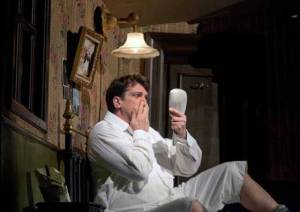
Irina Mishura (back to camera) as Mother Marie and Judith Forst as Madame de Croissy  Photo: Michael Cooper

Irina Mishura (back to camera) as Mother Marie and Judith Forst as Madame de Croissy
Photo: Michael Cooper

Judith Forst, with her exceptional dramatic power touches the peaks of the emotional agony of the dying prioress in all the right moments and measures. She brought to life the character of Madame De Croissy in full flavours. Jean-François Lapointe, a Quebec-born baritone, has that creamy aspect in his voice that is a right match for the role of the Marquis de la Force, Blanche’s father.     

The collaboration among director Robert Carsen, set designer Michael Levine, costume designer Falk Bauer, choreographer Philippe Giraudeau, and light designer Jean Kalman re-created for this production by Cor van den Brink, produced a coherent, smooth and effortless unfolding of this story from the beginning to the end.

The COC orchestra with Johanes Debus rendered the score with an emphasis on forcefulness as the underlying atmosphere of revolution, while eloquently expressing musical phrases, thereby revealing the influence of Stravinsky and Wagner.

Francis Poulenc himself lived most of his life in the historically turbulent time of two world wars and the communist revolution. He also suffered the death of several close friends and partners.  The libretto is based on a novel by Gertrude von le Fort, written in 1931 and inspired by the actual execution of 16 nuns during the Reign of Terror. Even though Poulenc’s association with the surrealist movement marks a  great deal of his works, this opera, composed only 57 years ago, rests mainly on the musical tradition that preceded his century.

Salome at the COC

May 3, 2013
Erika Sunnegårdh as Salome and Nathaniel Peake as Narraboth. Photo: Michael Cooper

Erika Sunnegårdh as Salome and Nathaniel Peake as Narraboth. Photo: Michael Cooper

A hundred and eight years ago Richard Strauss’s Salome was premiered in Dresden followed by 38 curtain bows. Shortly thereafter it was staged in fifty other theatres across Europe. At the Austrian première in Graz 1906, in the audience were Alban Berg, Giacomo Puccini and Gustav Mahler. The libretto is based on an Oscar Wilde play which inspired Strauss to write this opera. It is a biblical story about the death of John the Baptist in the captivity of Herod, the Roman governor of Judea.

A renowned Canadian film director, Atom Egoyan, directed the Richard Strauss’s Salome which was performed this season at the COC. In this biblical story of degenerate mores, princess Salome attempts to seduce Jochanaan, John the Baptist, who is held in the captivity of her stepfather Herod. Salome seduces the guard to bring the prisoner Jochanaan. She tries to seduce Jochanaan to kiss her. Failing to arouse any interest from the imprisoned prophet, the princess goes back to the banquet in Herod’s garden and agrees to perform the Dance of the Seven Veils for her lustful stepfather, on condition that he fulfill her wish.  She demands the severed head of Jochanaan to be delivered to her on a silver platter. Herod, although disgusted over such an idea, cannot retract on his promise. Seeing Salome fondling the severed head, Herod, in profound disgust, shrieks and declares her mad and fit for Sodom and Gomorrah, summoning the guards to kill Salome. The guards follow the order.

Herod, his wife and Salome abide in their quarters dressed in casual bathrobes.  A lack of splendour and signs of neglect in the bare garden of Herod, combined with the grey and green lighting, hint at the decay and disorder that must accompany such abominable deeds. Combining video projections and a theatre of shadows with the classical stage set, the story unfolds with coherence, but remains within the realm of the conventional. Yet the conventional cannot be at par with this shocking story and dramatic extremes of music delivered by the superb orchestra under conductor Johanes Debus.

In a Met production of Salome with Karita Matilla in the title role, her drunken dance delivers the true degenerate madness that carries the weight of this whole unhinged story. This production is short of this anchoring point. It is not enough that Herod is attending his garden party dressed in a wife-beater and pajamas under his orange bathrobe.  His lust and titillation are meek and pale.  For this magnitude of the abominable, the set and costumes appear as too conventional. The most revolting point in this opera should not be a princess kissing the severed head on the platter, but something that inevitably leads to it. 

Dance of the Seven Veils scene from the Canadian Opera Company’s production of Salome, 2013. Photo: Michael Cooper

Dance of the Seven Veils scene from the Canadian Opera Company’s production of Salome, 2013. Photo: Michael Cooper

Swedish-American soprano Erika Sunnagårdh as Salome has more than the required strength in her upper register for this role. Ms. Sunnagårdh delivered a superb performance. Richard Maragison as Herod was impressive in delivering transition from the anesthetized hedonistic boredom towards the agonizing despair of decision making in commanding the execution of the stepdaughter he adores. Martin Gantner, although vocally equal to the task, sang the role of John the Baptist with a stamina and resoluteness more suitable for a guerrilla-fighter than a prophet, having no compassion or forgiveness for the fallen woman.

Despite all these objections, the performance is a success, most notably for the singers and the orchestra.

Lucia di Lammermoor – a sad and confusing overkill

April 22, 2013

Lucia di Lammermoor is too tragic in itself to endure further layers of tragedy, without serious risk of sinking into irreparable overkill. There was an overkill with Lucia at the COC this season.

Oren Gradus as Raimondo and Anna Christy as Lucia in the Canadian Opera Company’s production of Lucia di Lammermoor, 2013. Conductor Stephen Lord, director David Alden, associate director Ian Rutherford, set designer Charles Edwards, costume designer Brigitte Reiffenstuel, original lighting designer Adam Silverman and lighting design re-creator Andrew Cutbush. Photo: Chris Hutcheson

Oren Gradus as Raimondo and Anna Christy as Lucia in the Canadian Opera Company’s production of Lucia di Lammermoor, 2013. Conductor Stephen Lord, director David Alden, associate director Ian Rutherford, set designer Charles Edwards, costume designer Brigitte Reiffenstuel, original lighting designer Adam Silverman and lighting design re-creator Andrew Cutbush. Photo: Chris Hutcheson

On top of everything tragic and unfortunate already provided in the libretto, Lucia is a child-bride and sexually abused. She has a toybox. She is like a character in a Charles Dickens’s story of dirty game of money and power, with youth and love as counterbalance. As if that were not enough, the story had to be spiced up with sexual abuse and incest.  American soprano Anna Christy responded dutifully to the additional demands of the title character. During Acts One and Two she spends a great deal of her stage time on her knees. The creative team got enthusiastic with the expressiveness about Lucia as a sexually abused child. Reviews in the daily papers speak about this sexually explicit content depicting the groping, tying of the hands to the bed frame, etc.  This is, I believe, the first time I can fully agree with the critic of the National Post.  (My strong disagreement about Einstein on the Beach and Semele remains.) On the other hand, historically looking, marriages were arranged, and the brides often were very young. Marriages among family members were customary. From that perspective it is probably a legitimate reading of Lucia’s plot.  All things considered, the real Lucia is more likely in reality to be something like the character depicted in this production, than a romanticized version of Lucia where she appears as a fully developed, fulfilled adult who truly goes mad after the dense climax, which is charged with the utmost cathartic extreme. Having said that, good taste is very important in the matters of depicting reality of cruelty, violence, and sex on stage.    

Visually, the stage is drained of any colour and the underlying spirit is drab and tired. Rain would make a fine contribution to the overall impression.  The final scene was supposed to be the suicide of Lucia’s sweetheart Edgardo, who cannot endure the tragic realization that Lucia in a single day  married another,  killed him on the wedding day, went mad, and died— while loving him faithfully throughout.  Lucia’s marriage to a wealthy suitor was a set up, arranged by her brother, who double-crossed both Lucia and Edgardo.

All would have been fine had it not been for the last moment, when Edgardo killed himself.  According to the various sources of this particular libretto, Edgardo “plunges a dagger to his own heart”[1] or “stabs himself”[2] or “stabs himself in the heart with a dagger”[3] and “stabs himself and expires”[4]. Carried away with the personal touch, this creative team have Edgardo kill himself with a gun. After shooting himself Edgardo sings further until Enrico finishes him off in a Jack Bauer style of finishing of an enemy. That was a real overkill, which then brings into question all the interpretative innovations mentioned before. By this last act Enrico acquires another char6acter trait, which makes him not only a selfish, immoral abuser and ruthless plotter but also a cruel murderer who cannot resist but apply a mercenary killing technique on his sister’s lover, who had already killed himself.

This particular Lucia di Lammermoor has some spooky elements of madness. The whole idea of deceiving the lovers and small-conning them individually is sufficiently wicked even for a 19th -century psychopath as seen from a 2013 North American viewpoint.  Adding sexual abuse and throwing in an additional murder is just too much.   

The stage interpretation of this libretto restricted bel canto potentials and  reduced the known qualities of this opera, limiting thereby the space for the singers. Steven Costello’s Edgardo was shaped with attentive and convincing phrasing. Brian Mulligan’s Enrico was on the side of strength. Without Costello’s lament and Mulligan’s strength, the whole project of this Lucia would hardly be able to stand on the wobbly knees of kneeling Lucia. This unfinished concept to some extent affected the orchestra, which could not attune to any particular dramatic quality of the sound except for a couple of effective caesure.


[1] 100 Great Operas and Their Stories, Henry V. Simon, Doubleday 1989, p. 269

[2] Eyewitness Companions Opera, Alan Riding & Leslie Dunton-Downer, DK 2006, p.155

[3] Ticket to the Opera, Phill Goulding, Fawcet Books,  1996 p.187

[4] A Night at the Opera, Sir Denis Forman, Random House, 1994, p.374

Owen McCausland shines in the title role of La Clemenza di Tito

February 12, 2013

Seasonal flu prevented Michael Schade from performing the title role on February 9, 2013. The opportunity  presented itself  for a young tenor Owen McCausland. Hopefully for Mr. McCausland this will turn out to be one of those career milestones after which everything changes because we the audience had a chance to see that he is a tenor to keep an eye on. At the incredible age of 22 he assumes the role of a Roman emperor with a maturity, confidence and conviction extraordinary for a singer at such an early stage in his career and at that age. A native of Saint John, New Brunswick he emerges as a talented young singer, a multiple year winner of the New Brunswick Competitive Festival of Music. We will see him again this spring in Salome. He appeared in the previous season in Puccini’s Gianni Schicchi, understudied a role of Spalanzani in the Tales of Hoffman, and just this season in a small role of a young sailor this month in Tristan and Isolde. In 2011 he was one of the winners of the COC Ensemble Studio competition.

Owen McCausland (front) as Tito and Neil Craighead as Publio in the La clemenza di Tito, 2013.  Photo: Michael Cooper

Owen McCausland (front) as Tito and Neil Craighead as Publio in the La clemenza di Tito, 2013. Photo: Michael Cooper

The authorities I usually research on the subject of opera more or less agree that La Clemenza di Tito is not an opera even its author would be particularly proud of. Mozart wrote it in less than three weeks for the money he desperately needed. It was written for the coronation of Leopold II, King of Bavaria. Mozart wrote it at the time when he was busy writing the Magic Flute, recycling a libretto which was used before by many lesser known composers. The plot is improbable. At a time when for lot  minor transgressions people were thrown into cages with  lions, it seems a little dubious that for  plotting the assassination of a Roman emperor, the conspirators would be forgiven and get away with it with only  a few mildly resentful “tsk tsks” from the emperor.  Yet, this is exactly what happens. It is a digestible piece of a little over two hours with plenty of roles for female voices, including two “trouser roles”, some beautiful duets and orchestration bearing a distinct Mozart flavour.  It is also a nice little opera that fills the season’s repertoire and gives the young singers an opportunity to break their stage fright and gain some valuable confidence-building  experience, or as is the case of Owen McCausland a chance to rise and shine. This is exactly how it appears this season at the Canadian Opera Company.

This production of the Chicago Opera Theater, directed by Christopher Alden, uses a simple set that remains unchanged throughout, resembling the Capitol of any capital that has it, including  joggers, lobbyists, warts and all. Many humorous details are sprinkled through acting and stage movements that give a touch of lightness to this dramatic plot with a happy ending.

In “trouser roles” there were Isabel Leonard, a young American soprano as Sesto, and Wallis Giunta as Annio. Robert Gleadow in the role of Publio, and Mirelle Asselin as Servilia were other COC Ensemble studio members who took part in this opera with praiseworthy performance. It was the commendable team work of young singers and the 28-year-old conductor, Daniel Cohen, a protégé of Daniel Barenboim.

Worth mentioning are the lighting designer Gary Marder and set designer Andrew Cavanagh Holland, whose delicate attention and attunement contributed to the overall success that staging of this piece permits.

Erotic and Esoteric Tristan and Isolde

February 3, 2013

This season the Canadian Opera Company’s home in Toronto is the place for revival of the 2005 production of  “Tristan and Isolde”, originally staged at the Opera Bastille in Paris. The truth of the proverbial phrase, that less is more, has been proven in this production of “Tristan and Isolde”. The acting role of singers was almost eliminated. The purpose of the costumes was to attract no attention whatsoever. The key visual elements of the stage are work of a visual artist Mr. Bill Viola. They are films and images projected onto the large screen in the background depicting the movements of water and fire, light and air. The majestic currents of Wagner’s score in its breath-like rhythm took the central role and carried each of us in the audience to a private inner journey. 

Peter Sellars in his director’s notes provided a reading of this libretto from the perspective of an esoteric quest with purification, awakening and transformation corresponding to the three acts of the opera. In light of his director’s notes, and stimulated by the visual projections on the screen, I attuned to the different roles in this opera as different aspects of a human being rather than as a plot with different characters. From this perspective, the representations of the sexual, emotional and intellectual in a human being were depicted in their polarity by Tristan and Isolde, Brangäne and Kurwenal, and Marke and Melot. Under the command of conductor Johannes Debus, Wagner’s orchestral reflections on love and death filled the air with scintillation and splendour, pulsating sublime erotic waves. “Tristan and Isolde” felt like a sacred initiation.

It occurred to me that instead of a traditional wedding ceremony, perspective spouses should be asked to listen to “Tristan and Isolde” while sitting silently and looking each other in the eyes, holding each other’s hands for the duration of this opera. After such an experience their gut feeling would crystallize more clearly towards yes or no, giving them a lot better idea if they want each other in marriage.  The rate of divorce might drop significantly if a couple who wish to become married are required to perform such a marriage test ceremony.

We were privileged to hear Ben Heppner in his signature role as Tristan, Melanie Diener as Isolde, Alan Held as Kurwenal, Daveda Karanas as Brangäne, Adam Luther as Shepherd, Robert Gleadow as Steersman, Owen McCausland as a Young Sailor, and Ryan McKinny as Melot. My favourite was Franz-Josef Selig as King Marke. The experience of listening to his singing resembles what I imagine might feel like raking your fingers through the treasure chest of the finest jewelry of pearls, gold and precious stones. 

The theatre felt like a giant pod where we the spectators were seeds being immaculately fertilized by waves of heavenly sounds from the stage and the pit, and at the end released into the cold winter night to grow the light with which we were impregnated.

An afternoon at the Glen Gould Studio

January 28, 2013

This cloudy, dry and gloomy Sunday afternoon in Toronto, 27 January 2013, was just the right day for a little recital at the Glen Gould Studio, a cozy venue of ideal proportions for a soloist and a piano. The concert was prefaced with the insightful historical and biographical details from the lives of the composers presented by Ms. Julia Zarankin (PhD in Comparative Literature) about the friendships between Mozart and Haydn, Schumann and Brahms, and Wolf and Mahler.
Most of the programme was songs on German poetry both literary and folk. It also included two famous arias from Mozart’s operas: “Deh’ vieni alla finestra” from “Don Giovanni” and “Smanie implacabili” from “Cosi fan tutte “. Baritone Russell Braun and mezzo soprano Erica Iris Huang were followed by pianists, Ms. Elina Kelebeev and Ms. Carolyn Maule.
It was a good day for Mr. Russell Braun, who effortlessly transformed the verses by his impeccable rendition and refined phrasing into a vivid gliding journey through a series of different emotions. A little more affection in Deh” vieni alla finestra would not harm, though. Ms. Erica Iris Huang has a powerful voice with still undiscovered potentials for breadth and refinement. It became more transparent in her rendition of “Smanie implacabili”, where her expressiveness has not yet explored all the potentials of this aria. The overall impression was that that both singers enjoyed the afternoon, as we in the audience did too.
My friend and I agreed that the most rewarding piece came from the pianist duo, co-founders and artistic directors of Off Centre Music Salon and spouses of one another, Ms. Ina Perkis and Mr. Boris Zarankin. They were playing Brahms’ own piano four-hand arrangement Concerto No. 1 in D minor, Op. 15 (1858) with zesty surrender. Warm and enthusiastic applause followed.
The modest but comprehensive programme brochure offered the complete text of the poems in the German original and English translation, and refreshingly–commercial free. Thanks to the generous patrons of this performance Ms. Katalin Schafer and Mr. Roger Moore, it was an afternoon worth attending at the Glen Gould Studio.
The next concert will be on April 28, 2013, celebrating philanthropists in music.

Glen Gould Studio, Toronto

Glen Gould Studio, Toronto

Einstein on the Beach and my fresh prayer to St. George

September 26, 2012


The truth has its frequency. Einstein on the Beach captures the frequency of the truth about human dysfunction in its many forms. The language is fresh because dysfunction is more apparent than ever. It is everywhere. Our daily language is abundantly dysfunctional and often stripped of any meaning. How are you?”… Have a nice day…This call may be monitored or recorded for quality assurance…Your call is important to us… This is a recording… I am sorry…
Is this dysfunction a genetic glitch, a loop embedded in the human source code which keeps us enslaved? Is this dysfunction an inability to crack open the boundaries and connect the fragmentized parts of ourselves scattered in an equally fragmentized, dysfunctional world.
Because of my job, I spend a lot of time in the courtroom. Here is an emotional recollection I had on the sounds of Einstein on the Beach. It is a recollection of a feeling of deafening, mind-numbing silence that filled the air for a fraction of a second at a real-life hearing at the court of appeal. It happened in a moment between the judge’s question and the answer which I am going to describe.
A year ago I was at a hearing before the court of appeal. The case was about to be finally dismissed on the preliminary question: Is there known cause of action? After hearing the procedural arguments, the appellant said: “I would like to say briefly what this case is about.” The judge interrupted: “Why would I need to know what the case is about”. The answer that followed: “For the reason of common sense” sent the situation back into the role-playing context of hierarchy and personalities.
The moment of silence between this question and the answer was for me charged with the noise of all sounds and yet quiet and numb. It lasted a second or less, yet it took many weeks for me to recover from the devastating effect of this silent noisy numbness. The images and music in Einstein on the Beach evoked that moment and expanded its noisy silence to infinity. It brought up visual and auditory tastes of that moment as if it was now revived under some kind of microscope, and I saw meaningless images and heard unrelated fragments of sounds embedded in the silence of that actual moment. The interesting thing is that my association to this short but memorable moment of life experience did not bring any emotion. It was neutral. Einstein on the Beach registered like a litmus where the absurd falls apart and becomes deconstructed down to its building molecules.
The enchanting beauty of Einstein on the Beach is that it felt broad enough to embrace any individual experiences of dysfunctionality. That is why I like Einstein on the Beach and can’t get enough of the bizarre, yet soothing meditative state to which it takes me.

Royal Opera tabloid about turning flesh into a zip-lock meat.

September 19, 2012

The real story of Anna Nicole is fascinating. In short: a single mother from a remote parochial town in Texas abandons her low-paid job selling fast-food fried chicken. She sets her mind on a career in dangerous proximity to pornography and prostitution. As a breast-augmented blond stripper she wins the heart of an 80-year-old billionaire. Six months into the marriage her sugar-daddy husband dies leaving his estate to be litigated between his children and his playboy-mate-of-the-year widow. The remainder of her life is a payback of hidden costs in making a livelihood by being DD-breast endowed, blonde and sexy. We learn, that much of Anna Nicole’s life as a widow takes place in tax-insulated and litigation-proof geographical locations. On the front of finding new revenue sources her vulturous lawyer friend advises that she give birth in a pay-per-view live broadcast (spearheading thereby the yet-to-come era of reality shows). Three days after her daughter is born, her twenty-year-old firstborn dies. The death of her son is unbearable and six months later she surrenders her own life, posing one more time for the tabloids as a pretty corpse from her unzipped body bag. Her baby daughter is left at the mercy of a flock of vulturous claimant fathers who are invigorated by the baby’s entitlement to wealth from her unfortunate mother.

The libretto abounds with educational verses such as: what distinguishes illegal prostitution from legal lap-dancing, the capital gain returns from investment in breast augmentation surgery, and associated risks. There are many proverbial lines, such as the one for horny nursing-home males: “hump and dump, spunk and leave” or the pill-popper’s comfort: “ease the pain, block the shame, down the hatch wah-ooo”.

Making an opera on the life and death of Anna Nicole is similar to attempting to capture in a painting or an artistic photography the beauty of galloping giraffes in Serengeti at sunset. It is bound to sink down to kitsch. Everything in the actual life and the real death of this shooting star is crystalized in a “National Geographic” type of perfection. In itself her life, including her death, is an amazing cliché. It was risky and difficult to attempt an artistic take of something so perfect and complete in its own pathetic domain, exactly the way it happened. The interest of the Royal Opera House to commission an opera about the life of an American tabloid star, with the prominent role of paparazzi-style photos documenting her death, is too obvious, and I would say lacking in good taste. For this opera house it was not a good choice of story.

Eva Maria Westbroek made an honest effort to portray Anna Nicole in singing, acting, and her American accent. Unfortunately, the overall concept was aiming equally towards the story-telling of the protagonist’s life and the deconstruction of the failed American dream, and, sprinkled with too many elements of farce. This indecision, coupled with excessive descriptiveness, blurred the focus and undermined the shaping up of the key character. Furthermore, the costume designer made Ms. Westbroek look at the peak of the character’s career in the sex industry, like Miss Piggy of the Muppets Show. Ms. Westbroek if of courpulent physique, but very well shaped. It is shame that the costume designer missed the opportunity to bring up her gorgeous look. Musically, we heard it all from Alban Berg. The jazz and pop elements promised by the composer in the DVD additional materials are pale and identifiable only by forensic means. The libretto aimed to elevate Anna Nicole’s version of the failed American Dream into a universal story of the destructive currents of big money and fame. But the fatal proximity of a paparazzi pimp in the life of Anna Nicole was not brought up in the story as told from the podium of the Royal Opera House.

The side effect was that too many threads were touched upon, and none completely followed through. These lines of the libretto were explored at the expense of the profile and fate of the main character. The character of Anna Nicole was oversimplified and reduced. The actual pinnacle of her life, her real-life Pietà moment, the moment of her son’s death literally in her arms after which she quickly wilted into her own premature death was somehow missed. Her own death, captured for the tabloids, which made its way into mainstream media headlines, went almost unnoticed in this libretto. It is as if we were told that had she been shrewder and had calculated her moves more cleverly, she could have lived happily ever after, mingling among the Hollywood celebrities, but she blew it because she was stupid. The tragedy of the real-life Anna Nicole lies in her false belief that she could be a good mother and at the same time be a poor, sexy, stripper bride of a filthy-rich dying old man. The marriage of such extremes is impossible. In such tension only vultures thrive.

Real life abounds with cliché melodramas and beyond-Monty Python absurdities. Paraphrasing these stories does not constitute a creative process resulting in a piece of art.
In a few days the Toronto Serbian Film Festival will present a film of political surrealism that surpasses the stellar heights of Monty Python absurdities. It is a real life story of a Canadian actor who played a detective in the American TV series “Tropical Heat”. The series was a failure and discontinued after its third season. The only place it was shown with success was Serbia. At the time the series was released, the country was under international sanctions, its entire population condemned, imprisoned to slow and humiliating starvation. “Tropical Heat” was the only connection with the world outside the walls of isolation showing the world of sandy beaches, a dashing pony-tail detective, and his many babes. “Tropical Heat” was the only foreign TV series shown, over and over again. In a collective despair and in futile civil protest against Milosevic regime, the “Tropical Heat” detective Nick Slaughter became the epitome of the protest. Rhyming slogans appeared seeking presidential candidacy for the fictional character Nick Slaughter. Years later the Canadian actor who played the role of detective Nick Slaughter found himself forgotten, unemployed and in debt, living in the basement of his parents’ house back home in Canada, unaware of his fame at the other end of the world until one day…
His teenage son comes and tells him: “Dad, Nick Slaughter has 17 thousand fans on Facebook. They are all from Serbia”. The actor Rob Stewart wastes no time on imponderables: “Parents’ basement or Serbia? The film “Slaughter Nick for President”, directed by Rob Stewart will be shown this fall at the Toronto Serbian Film Festival. Let’s see how Nick Slaughter deals with the impossible real-life story.

Some events are good for tabloids; some life-stories are tabloids themselves. Maybe a good story to commission for the Royal Opera House would be about a lawsuit launched in a speed-of-light manner guarding the right to privacy of a newly minted young princess sunbathing topless on the terrace of, so cliché, a château in France. The word “grotesque” was already employed in exaggerated PR statements so my unsolicited advice to the Royal Opera House is: commission an operetta. Now.

Carmen directed by Calixto Bieito

August 6, 2012

During the last two weeks of June and early July, 2012, the legendary Teatro la Fenice di Venezia, was the stage for Carmen by Calixto Bieito. It was a first-class performance With a great cast of singers. Yet performing the same role in a densely packed schedule takes its toll. From the peaks of  Act One to the closing scene there were moments that somehow felt lacking in energy. Nothing went wrong.  It is just a personal impression  that  even the most provocative production from the top artists, if repeated over many days in a short period, carries a risk of coming across as routine. Or, it may be the effect of the broader context of a magnificent city, once vibrant with its own authentic life which today caters to a global tourist fantasy.   

photo by Hans-Jorg Michel

photo by Hans-Jörg Michel

In the title role was mezzo-soprano Beatrice Uria Monzon. Born in France , and educated there as a singer, in France,  Ms. Monzon performed her first Carmen almost 20 years ago.  Her Carmen today is an attractive, liberated woman, mature yet youthfully  foolish, inhabiting her body with surrendering abandon, confident in her natural beauty. Her Carmen needs no hair-styling, and her cloths are ordinary, more hiding  than revealing , allowing the sex appeal of her Carmen to come across subdued, yet powerful. Her singing  described as a “dark golden” voice,  was most electrifying in Act One.   

Aleksander Vinogradov as Escamillo rose to  stardom by reaching the stage of the Bolshoi Theatre at the age of 21. His presence on many of the main opera stages of the world has been received with praise and recognition.  The richness, clarity and depth of his voice infused his Escamillo with remarkable liveliness.

For Stefano Secco it was a début in the role of Don José. This young tenor from Milan is in the  fourth year of his international career. Before discovering his vocal talent he played drums. In 1995 he won the Competition for Young Opera Singers of Europe. This spring he was greeted by a Seattle opera audience in the role of Pinkerton. 

Ekaterina Bakanova, another young singer from Russia, appeared as Micaëla.  At the age of 28 she is capturing the attention of European critics and audiences as a rising soprano star. The Italian press praised her enthusiastically for this role.    

The première of this Carmen was in Barcelona two years ago. Whether it is the plot of Don Giovanni, Aida, or Carmen, Calixto Bieito finds the way to frame the story in images and contexts of the distressed contemporary world.

The opening of  Act One introduces a drunken man, long past his prime, sporting a thick golden chain and a wife-beater under his white suit, draws the attention of the audience by imitating a magician’s  trick stacking a red silk scarf in his fist. Instead of the illusionist’s effect, he exclaims: “L’amor és com la mort”       

Calixto Bieito carries on the story of extreme emotions in his merciless way without an aim to please the senses or portray passion with the usual colour.  Carmen’s  theme of love and death takes place in a void, barren space where only two relatively fixed structures exist: a flagpole and a telephone booth.   

Long before Mercedes-Benz cars were introduced to the stages of opera houses, this brand of car rose to the level of a status symbol of wealth and success. It was particularly favoured among dictators, high-end criminals and gypsies. Mercedes became a substitute for a gold tooth. So in Act Two the tavern, as indicated in the libretto, is another barren outdoor space to which Carmen, her friends and the officers gather arriving in a dusty Mercedes.  Plastic folding chairs, an artificial Christmas tree, and cases of beer are drawn from the trunk to recreate the gathering environment for communities rising around the milestones set up by flagpoles and telephone booths.

In Act Three the ominous silhouette of a giant black bull against the night sky hovers over a makeshift flea market of contraband merchandise. Such places can be seen today where beaten-up Mercedes of questionable provenance congregate under the newly designed flags on the flagpoles.    

The cheering crowd saluting the arrival of celebrated toreador Escamillo, revived the energy lost around the fleet of Mercedes in Act Three. It was a high point of this performance. It lasted long enough to allow for reflection about all cheering crowds, whether their joy is directed to a movie star arriving on Oscar night in Hollywood, a favourite soccer team, or a statesman attending a military parade. All cheering crowds have in common a joy projected outside. Like any other joy originating from illusion it fails to take root in the heart, leaving only a vague, dry picture in one’s memory lacking in flavour of liveliness once felt as real.      

What feels frightfully real is a bankrupt world that Calixto Bieito re-creates on the stage. It feels as a scandalous truth of the state of humanity today.

No saviour from up high delivers

May 14, 2012

Jane Archibald as Semele and William Burden as Jupiter

The last opera of this season at the Canadian Opera Company, Semele by Georg Frideric Handle, is also the most noteworthy production of this season. It brings a fresh breeze of new sensibility and goes to say that the interpretational possibilities of myths are limitless.  

The director and set designer Zheng Huan told the ancient myth of Semele on three parallel planes. During the overture a muted subtitled documentary tells the story of a tragedy which took place in an abandoned temple located in a small remote town in China. In recent times the temple served for grain storage. After this use was abandoned, the inhabitants decided to let the poorest family use the temple as their home. The parents of a mentally disturbed bachelor hoped that with this new home their son would have better chances to marry. He married, but soon thereafter became consumed by jealousy and murdered his wife. The criminal trial resulted in a death sentence and he died before the firing squad. In this true story Zheng Huan recognized a parallel with the ancient myth. The god Jupiter, fell  in love with a Thebian princess, the mortal Semele. When Jupiter’s wife discovered the adultery of her husband she tricked Semele into challenging Jupiter to promise her that he would appear before her not merely as a human, but in all his godly splendour.

When a mortal woman pokes at a god to show his true nature, she gets burned to death as a collateral damage. Semele is certainly not the only princess who found her premature and sudden demise when seeking “no less than all in full excess”.

This production abounds with stunning visual effects. The actual original wooden temple seen in the documentary is the centrepiece of the stage. The explicit  portrayal of the pleasures of physical love include, horny donkey, and choreography inspired by  figurae veneris, or the Kama Sutra. Yet there is nothing distasteful, and the spirit of joy and pleasure prevails. Those who felt offended by display of  physical love may be reminded that the purpose of theatre is not to conform with particular taste, but to be a sandbox for playfulness and thinking out of the box.

The third layer of the story is only hinted at by questioning the wisdom of mortals when they get dangerously close to the gods.  The audience is left to ponder about the director’s message choosing to end this opera with the chorus’s humming the Internationale, the hymn of collective consciousness. As if Zheng Huan reminds us: “no saviour from up high delivers”. The self-reliance and self-awareness would better serve unhappy humanity, rather than unrealistic ambitions aimed at the sphere out of their reach. Apart from the gods of ancient myths and contemporary religions, there are also mortals who rule the world as if they were gods. Different but no lesser dangers await mortals in challenging the powers of those self-proclaimed gods, as well of those mortals who usurp the status of gods.

The second performance of Semele at the Canadian Opera Company was received well by the audience. Rinaldo Alessandrini, a visiting conductor from Italy, led the orchestra with confidence and enthusiasm leading those who were alarmed by the creative interventions to surrender to the beauty of the music and singing alone. Jane Archibald as Semele is a rising star. Her technique and attention to the orchestra resulted in a perfect synchronicity inspiring the conductor to join the audience applauding her.  

Jane Archibald as Semele and William Burden as Jupiter

The staging and regie of Semele is unorthodox and thought-provoking. But isn’t art that very language that constantly seeks to expand the boundaries of expression? The history of art abounds with examples of enraged critics screaming their scorching invective at the artists who dare to let their creative impulses say anything beyond the established convention.

The Canadian Opera Company should be proud for bringing this production to its stage.


Follow

Get every new post delivered to your Inbox.